BASIC PRINCIPLES AND TECHNIQUES IN ORGANIC CHEMISTRY
Organic chemistry is the chemistry of carbon compounds except oxides of carbon and metal carbonates. The term organic literally means derived from living organism. All organic compounds contain carbon as their essential constituent. Carbon atom has unique property to form bonds with other carbon atoms. This property of forming bonds with atoms of the same element is called catenation.
Carbon form strong bonds with many others elements and especially with other carbon atoms to form chains and rings that gives rise to millions of organic compounds.
CLASSIFICATION OF ORGANIC COMPOUNDS
Organic compounds are broadly classified in two ways.
1] Based on carbon skeleton
Aliphatic compounds
These are the compounds in which carbon atoms are joined to form an open chain. Their structure may consist of straight chain or branched chain.
e.g. CH3 – CH2 – CH2 – CH3
Cyclic compounds
These are the compounds in which carbon atoms are joined to form one or more rings. They are further classified into two types.
a] Homocyclic or carbocyclic
In these compounds, the ring is made up of carbon atoms only. They are further divided into two types.
i) Alicyclic compounds
These compounds show some of the properties similar to those of aliphatic compounds. Carbon atoms are linked by single bonds only.

ii) Aromatic compounds
These are the compounds which contains at least one aromatic ring which resembles benzene in their chemical behavior.

b] Heterocyclic compounds
These compounds include one or more heteroatoms like O, N, S etc. in the ring of carbon atoms. They are also divided into two types.
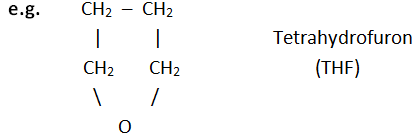
i) Hetero – alicyclic compounds
Alicyclic compounds which contain at least one heteroatom in the ring are called hetero-alicyclic compounds.
ii) Hetero – aromatic compounds
Aromatic compounds which contain at least one heteroatom in the ring are called hetero – aromatic compounds.

2] Based on functional group
An atom or a group of atoms in the organic molecule which determines its characteristic chemical properties is called the functional group.
e.g. – OH, - X, - CHO, - COOH, - NH2, etc. are functional group. The chemistry of every organic molecule is determined by the functional group it contains.
Homologous series
A series of organic compounds each containing a characteristic functional group, and the successive members differ from each other in molecular formula by a –CH2– (methylene) group is called homologous series.

No comments:
Post a Comment