Tuesday, 28 February 2023

ANALYTICAL CHEM 1


PURIFICATION OF ORGANIC COMPOUNDS

The purification of organic compounds involves the following processes.

1. Crystallization

This is the most common method used to purify organic solids which dissolve in particular solvent. The purification is done on the basis of differences in solubility of a given organic compound and impurities.


2. Sublimation

It is a process which is used for solids which directly change into vapor state upon heating without passing the liquid state and vapors on cooling give back the solid Substance. Impure samples of naphthalene, anthracene, camphor, etc. are purified by this method.


3. Distillation

The process in which liquid is converted into its vapor phase at its boiling point and the vapors is then condensed back to liquid on cooling is known as distillation. This method is used if the organic liquid is stable at its boiling point and it contains non – volatile impurities.


4. Fractional distillation

The process of separating and purifying the components of a mixture of two or more miscible liquids having different boiling points is known as fractional distillation. The liquid which is more volatile distills out first leaving behind the less volatile liquid in the distillation flask.


5. Steam distillation

Liquids which are immiscible with water but are steam volatile are separated by this technique. Aniline, nitrobenzene, bromobenzene etc. can be steam distilled.


6. Fractional crystallization

The process of separating the components of a mixture of two or more solids, having different solubilities in the same solvent at the same temperature, by step – wise crystallization is known as fractional crystallization.


7. Differential extraction

The organic solvents like benzene, chloroform, petroleum ether etc. are immiscible with water such solvents are used to extract an organic compound present in aqueous solution by the method of differential extraction.


8. Chromatography

Chromatography is the technique used for the separation, isolation, purification and identification of constituents of a mixture. This technique depends on the distribution of the mixture between two phase, one stationary phase and other moving or mobile phase. Depending upon the principle involved, it is divided into two types.


a) Adsorption chromatography

It is based on the principle of differential adsorption. Different compound are adsorbed on adsorbent to different degrees. It also has two types i) column chromatography and ii) thin – layer chromatography (TLC).


b) Partition chromatography

This technique is based on continuous differential partitioning of components of a mixture between stationary and mobile pha

Hydrocarbons


 BASIC PRINCIPLES AND TECHNIQUES IN ORGANIC CHEMISTRY

Organic chemistry is the chemistry of carbon compounds except oxides of carbon and metal carbonates. The term organic literally means derived from living organism. All organic compounds contain carbon as their essential constituent. Carbon atom has unique property to form bonds with other carbon atoms. This property of forming bonds with atoms of the same element is called catenation

Carbon form strong bonds with many others elements and especially with other carbon atoms to form chains and rings that gives rise to millions of organic compounds.


CLASSIFICATION OF ORGANIC COMPOUNDS

Organic compounds are broadly classified in two ways.

1] Based on carbon skeleton


Aliphatic compounds

These are the compounds in which carbon atoms are joined to form an open chain. Their structure may consist of straight chain or branched chain.

e.g. CH3 – CH2 – CH2 – CH3

Cyclic compounds

These are the compounds in which carbon atoms are joined to form one or more rings. They are further classified into two types.

a] Homocyclic or carbocyclic

In these compounds, the ring is made up of carbon atoms only. They are further divided into two types.

i) Alicyclic compounds

These compounds show some of the properties similar to those of aliphatic compounds. Carbon atoms are linked by single bonds only.

Cyclopropane - Class 11th Organic chemistry Notes

ii) Aromatic compounds

These are the compounds which contains at least one aromatic ring which resembles benzene in their chemical behavior.

Phenol - Organic Chemistry Notes

b] Heterocyclic compounds

These compounds include one or more heteroatoms like O, N, S etc. in the ring of carbon atoms. They are also divided into two types.

i) Hetero – alicyclic compounds

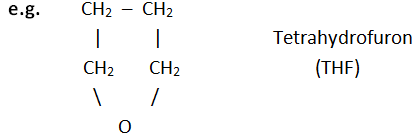
Alicyclic compounds which contain at least one heteroatom in the ring are called hetero-alicyclic compounds.

Tetrahydrofuron

ii) Hetero – aromatic compounds

Aromatic compounds which contain at least one heteroatom in the ring are called hetero – aromatic compounds.

Pyridine Organic chemistry

2] Based on functional group

An atom or a group of atoms in the organic molecule which determines its characteristic chemical properties is called the functional group.

e.g.   – OH, - X, - CHO, - COOH, - NH2, etc. are functional group. The chemistry of every organic molecule is determined by the functional group it contains.

Homologous series

A series of organic compounds each containing a characteristic functional group, and the successive members differ from each other in molecular formula by a –CH2– (methylene) group is called homologous series.