Thursday, 8 February 2024

Chem Study Tips


Maharashtra HSC Chemistry Preparation

Focus more on organic and inorganic chemistry as they are equally important. Keep a list of all organic formulas and inorganic equations with molecular reactions. Practice proper diagrams with proper labeling of chapters like 'solid-state, electron chemistry'. Revise 'structure of compounds' and also the list of formulae, giving importance to symbols and SI units so that it becomes easy to revise. Learn more from the points below:

  • To begin, go through all the concepts and understand them. If the concepts are clear, then students can  score well
  • Memorize easy parts, and note down important parts
  • After going through all the concepts, solve Maha Science model question papers
  • Stick to syllabus to score well in Chemistry
  • For Chemistry, diagrams are important. Practice diagrams wherever necessary so as not to get confused
  • Keep a handy note with all the formulae, symbols
  • Practice Maharashtra HSC Science question papers of previous years' and get them checked by a teacher
  • Write point-wise for short answers and draw diagrams wherever required 
  • Write point-wise for long answers and for numerical problems – write data, formulae, and substitute properly. Write the final answer with the correct unit

Wednesday, 26 July 2023

12th STD BASICS

INDUCTIVE EFFECT

 The polarization of a σ bond due to electron withdrawing or electron donating effect of adjacent groups or atoms is referred to as inductive effect. 

A sigma bond between two atoms, which differ in their electronegativity, is polarized due to displacement of bond pair towards the more electronegative atom. In this process, the electronegative atom gets partial negative charge while the other atom gets partial positive charge. Thus induced polarity is transmitted through the sigma bonds in the molecule by creating a permanent dipole. This phenomenon is referred to as inductive effect.

It is represented by an arrow pointing towards the more electronegative atom carrying partial negative charge.


inductive effect polarization of sigma bond

Salient features of inductive effect 

* It arises due to electronegativity difference between two atoms forming a sigma bond. 

* It is transmitted through the sigma bonds. No pi bonds are involved.

* The magnitude of inductive effect decreases while moving away from the groups causing it. 

* It is a permanent effect. It may create permanent dipole in the molecule.

* In general, the inductive effect is relatively weak and is overshadowed by other electronic effects like resonance effect, hyperconjugation etc.

* It influences the chemical and physical properties of compounds.

EXAMPLE OF INDUCTIVE EFFECT

The C-Cl bond in the butyl chloride, CH3-CH2-CH2-CH2-Cl is polarized due to electronegativity difference. The electrons are withdrawn by the chlorine atom. Thus the first carbon atom gets partial positive charge. In turn, this carbon atom drags electron density partially from the next carbon, which also gets partial positive charge. This will continue further and is how the inductive effect is transmitted through the carbon chain.

inductive effect example 

One must note that the inductive effect weakens away along the chain and is not that much significant beyond the 3rd carbon atom.

Also note that inductive effect is a permanent effect and is inherent to the molecule, while the electromeric effect is a temporary effect is only created in the presence of attacking electrophilic or nucleophilic reagents.

TYPES OF INDUCTIVE EFFECT

The inductive effect is divided into two types based on the electron withdrawing or electron releasing nature of atom/group inducing it. The strength of inductive effect is measured by comparing with that of hydrogen.

1) Negative inductive effect (-I):  

The electron withdrawing nature of groups or atoms is called as negative inductive effect. It is indicated by -I. Following are the examples of groups in the decreasing order of their -I effect: 

NH3+ > NO2 > CN > SO3H > CHO > CO > COOH > COCl > CONH2 > F > Cl > Br > I > OH > OR > NH2 > C6H5 > H 

2) Positive inductive effect (+I):  

It refers to the electron releasing nature of the groups or atoms and is denoted by +I. Following are the examples of groups in the decreasing order of their +I effect. 

C(CH3)3 > CH(CH3)2 > CH2CH3 > CH3 > H

Why alkyl groups are showing positive inductive effect?

Though the C-H bond is practically considered as non-polar, there is partial positive charge on hydrogen atom and partial negative charge on carbon atom. Therefore each hydrogen atom acts as electron donating group. This cumulative donation turns the alkyl moiety into an electron donating group.

inductive effect by methyl group

APPLICATIONS OF INDUCTIVE EFFECT

Stability of carbocations (carbonium ions): 

The stability of carbocations increase when +I groups like alkyl groups are present adjacent to positively charged carbon. The +I groups reduce the positive charge on the carbon by donating negative charge density through positive inductive effect. This results in greater stability of carbocation.

Whereas, the -I groups destabilize the carbocations as they increase the positive charge by withdrawing electron density.

Note that any factor that increases the charge (either negative or positive) on an ion results in destabilization while any factor that reduces the charge results in stabilization of that ion.

For example, the order of stability of a few carbocations containing alkyl groups is as follows: 

 inductive effect - stability order of carbocations

The tertiary carbocation containing three alkyl groups is more stable than the secondary carbocation with two alkyl groups and which in turn is more stable than the primary carbocation. Methyl carbocation is the least stable among the given.

Stability of free radicals: 

In the same way the stability of free radicals increases with increase in the number of alkyl groups. 

Thus the stability of different free radicals is:

 inductive effect stability of free radicals

Stability of carbanions: 

However, the +I groups decrease the stability of carbanions while the -I groups increases their stability.

For example, the alkyl groups (+I) donate electron density to the negatively charged carbon resulting in destabilization of carbanion.

Thus the order of stability of following carbanions is:

inductive effect stability of carbanions 

Now the order is reversed. The tertiary carbanion is least stable while the methyl carbanion is most stable among the given.

Acidic strength of carboxylic acids and phenols: 

A protonic acid is always in equilibrium with its conjugate base that is formed by loss of a proton. Any factor that stabilizes the negatively charged conjugate base favors greater ionization of acid. i.e increases the acidic strength.

The electron withdrawing groups showing negative inductive effect (-I) reduce the negative charge on the conjugate base (like carboxylate ion) by pulling the electron density and thus by stabilizing it. Hence the acidic strength increases when -I groups are present. 

On the contrary, the +I groups decrease the acidic strength as they destabilize the conjugate base of acid (anionic) by releasing electron density which in turn increases the negative charge on the anion and thus destabilizing it.

E.g. 

i) The acidic strength increases with increase in the number of electron withdrawing Fluorine atoms as shown below. 

CH3COOH < CH2FCOOH < CHF2COOH < CF3COOH 

ii) Formic acid is stronger acid than acetic acid since the –CH3 group destabilizes the carboxylate ion. 

On the same lines, the acidic strength of phenols increases when -I groups are present on the ring. 

E.g. The p-nitrophenol is stronger acid than phenol since the -NO2 group is a -I group that withdraws electron density. Whereas, the para-cresol is weaker acid than phenol, since the -CH3 group shows positive inductive effect (+I). 

For example, the order of acidic strength following phenols is:

 inductive effect acidity of phenols

Basic strength of amines: 

The electron donating groups like alkyl groups increase the basic strength of amines whereas the electron withdrawing groups like aryl groups decrease the basic nature. Therefore alkyl amines are stronger Lewis bases than ammonia, whereas aryl amines are weaker than ammonia. 

Thus the order of basic strength of alkyl and aryl amines with respect to ammonia is :CH3NH2 > NH3 > C6H5NH2 

Reactivity of carbonyl compounds:

The +I groups increase the electron density at carbonyl carbon. Hence their reactivity towards nucleophiles decreases. Thus formaldehyde is more reactive than acetaldehyde and acetone towards nucleophilic addition reactions. 

Thus the order of reactivity follows:

 inductive effect reactivity of carbonyl compounds aldehydes and ketones

Monday, 3 April 2023

11th Chemisty Study Tips

  1. Some basic concepts of chemistry -Just have a view on Dalton's atomic theory. Prepare numericals on MOLE CONCEPT. Be clear with the terms like molar mass , percentage composition , empirical and molecular formula.
  2. Structure of atom- This is one of the basic chapter . You must have a good command over the chapter. There are many formulas used so write them on a page and revise them on a regular basis. You will encounter many rules such as Aufbau principle ,Pauli exclusion principle, Hunds rule etc. Practice numerical based on electronic configuration
  3. Classification of elements and periodicity in properties - Many question comes from this chapter in JEE main and Advanced. You have to go thorough with the concepts such as atomic radii, ionic radii, ionization enthalpy, electron gain enthalpy and electronegativity etc. DON'T FORGET TO MEMORIZE THE EXCEPTIONS.
  4. Chemical bonding and molecular structure-Have a clear understanding of VSEPR theories , hybridization involving s, p and d orbitals and shapes of some simple molecules.
  5. States of matter : Gases and Liquids - You can take this chapter on a lighter note from the competition point of view. Learn concepts such as Boyle's law, Charles law, Gay Lussac's law, Avogadro's law, ideal behaviour, empirical derivation of gas equation, Avogadro's number and ideal gas equation
  6. Chemical thermodynamics -An important chapter from JEE main and Advanced point of view. Numericals comes every year in the board exam or in the competition. So prepare numericals well. Practice concepts such as Gibbs energy change for spontaneous and nonspontaneous process, laws of thermodynamics
  7. Equilibrium - Very important chapter from competition point of view. Le Chateliers principles, ionic equilibrium, ionization of acids and bases degree of ionization etc should be practiced.
  8. Redox Reactions - Conceptual Questions from topics such as oxidation number, balancing redox reactions, in terms of loss and gain of electrons and change in oxidation number, applications of redox reactions are asked frequently.
  9. S-block elements - This chapter comes under inorganic section. It is advisable to mug inorganic section.
  10. Some p block elements- This chapter also comes under inorganic section so the same advice.
  11. Organic chemistry and some basic principles and techniques - To get an edge over your peers you must excel this chapter. Many peoples find organic to be the hardest but trust me if you're show a little interest in it, it could give you the best return. Practice IUPAC nomenclature .Various effects such as inductive effect electromeric effect resonance and hyperconjugation.
  12. Hydrocarbons - Everything is important in this chapter. Dont ever try to ignore them because they are the basics and they are carried further in your class 12 chemistry.
  13. Environmental chemistry - This is the most ignored chapter from the student's perspective. But a question usually comes in JEE main examination.

Tuesday, 28 February 2023

ANALYTICAL CHEM 1


PURIFICATION OF ORGANIC COMPOUNDS

The purification of organic compounds involves the following processes.

1. Crystallization

This is the most common method used to purify organic solids which dissolve in particular solvent. The purification is done on the basis of differences in solubility of a given organic compound and impurities.


2. Sublimation

It is a process which is used for solids which directly change into vapor state upon heating without passing the liquid state and vapors on cooling give back the solid Substance. Impure samples of naphthalene, anthracene, camphor, etc. are purified by this method.


3. Distillation

The process in which liquid is converted into its vapor phase at its boiling point and the vapors is then condensed back to liquid on cooling is known as distillation. This method is used if the organic liquid is stable at its boiling point and it contains non – volatile impurities.


4. Fractional distillation

The process of separating and purifying the components of a mixture of two or more miscible liquids having different boiling points is known as fractional distillation. The liquid which is more volatile distills out first leaving behind the less volatile liquid in the distillation flask.


5. Steam distillation

Liquids which are immiscible with water but are steam volatile are separated by this technique. Aniline, nitrobenzene, bromobenzene etc. can be steam distilled.


6. Fractional crystallization

The process of separating the components of a mixture of two or more solids, having different solubilities in the same solvent at the same temperature, by step – wise crystallization is known as fractional crystallization.


7. Differential extraction

The organic solvents like benzene, chloroform, petroleum ether etc. are immiscible with water such solvents are used to extract an organic compound present in aqueous solution by the method of differential extraction.


8. Chromatography

Chromatography is the technique used for the separation, isolation, purification and identification of constituents of a mixture. This technique depends on the distribution of the mixture between two phase, one stationary phase and other moving or mobile phase. Depending upon the principle involved, it is divided into two types.


a) Adsorption chromatography

It is based on the principle of differential adsorption. Different compound are adsorbed on adsorbent to different degrees. It also has two types i) column chromatography and ii) thin – layer chromatography (TLC).


b) Partition chromatography

This technique is based on continuous differential partitioning of components of a mixture between stationary and mobile pha

Hydrocarbons


 BASIC PRINCIPLES AND TECHNIQUES IN ORGANIC CHEMISTRY

Organic chemistry is the chemistry of carbon compounds except oxides of carbon and metal carbonates. The term organic literally means derived from living organism. All organic compounds contain carbon as their essential constituent. Carbon atom has unique property to form bonds with other carbon atoms. This property of forming bonds with atoms of the same element is called catenation

Carbon form strong bonds with many others elements and especially with other carbon atoms to form chains and rings that gives rise to millions of organic compounds.


CLASSIFICATION OF ORGANIC COMPOUNDS

Organic compounds are broadly classified in two ways.

1] Based on carbon skeleton


Aliphatic compounds

These are the compounds in which carbon atoms are joined to form an open chain. Their structure may consist of straight chain or branched chain.

e.g. CH3 – CH2 – CH2 – CH3

Cyclic compounds

These are the compounds in which carbon atoms are joined to form one or more rings. They are further classified into two types.

a] Homocyclic or carbocyclic

In these compounds, the ring is made up of carbon atoms only. They are further divided into two types.

i) Alicyclic compounds

These compounds show some of the properties similar to those of aliphatic compounds. Carbon atoms are linked by single bonds only.

Cyclopropane - Class 11th Organic chemistry Notes

ii) Aromatic compounds

These are the compounds which contains at least one aromatic ring which resembles benzene in their chemical behavior.

Phenol - Organic Chemistry Notes

b] Heterocyclic compounds

These compounds include one or more heteroatoms like O, N, S etc. in the ring of carbon atoms. They are also divided into two types.

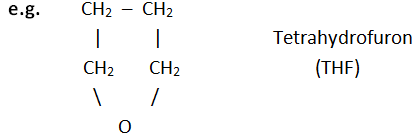
i) Hetero – alicyclic compounds

Alicyclic compounds which contain at least one heteroatom in the ring are called hetero-alicyclic compounds.

Tetrahydrofuron

ii) Hetero – aromatic compounds

Aromatic compounds which contain at least one heteroatom in the ring are called hetero – aromatic compounds.

Pyridine Organic chemistry

2] Based on functional group

An atom or a group of atoms in the organic molecule which determines its characteristic chemical properties is called the functional group.

e.g.   – OH, - X, - CHO, - COOH, - NH2, etc. are functional group. The chemistry of every organic molecule is determined by the functional group it contains.

Homologous series

A series of organic compounds each containing a characteristic functional group, and the successive members differ from each other in molecular formula by a –CH2– (methylene) group is called homologous series.


Friday, 4 September 2020